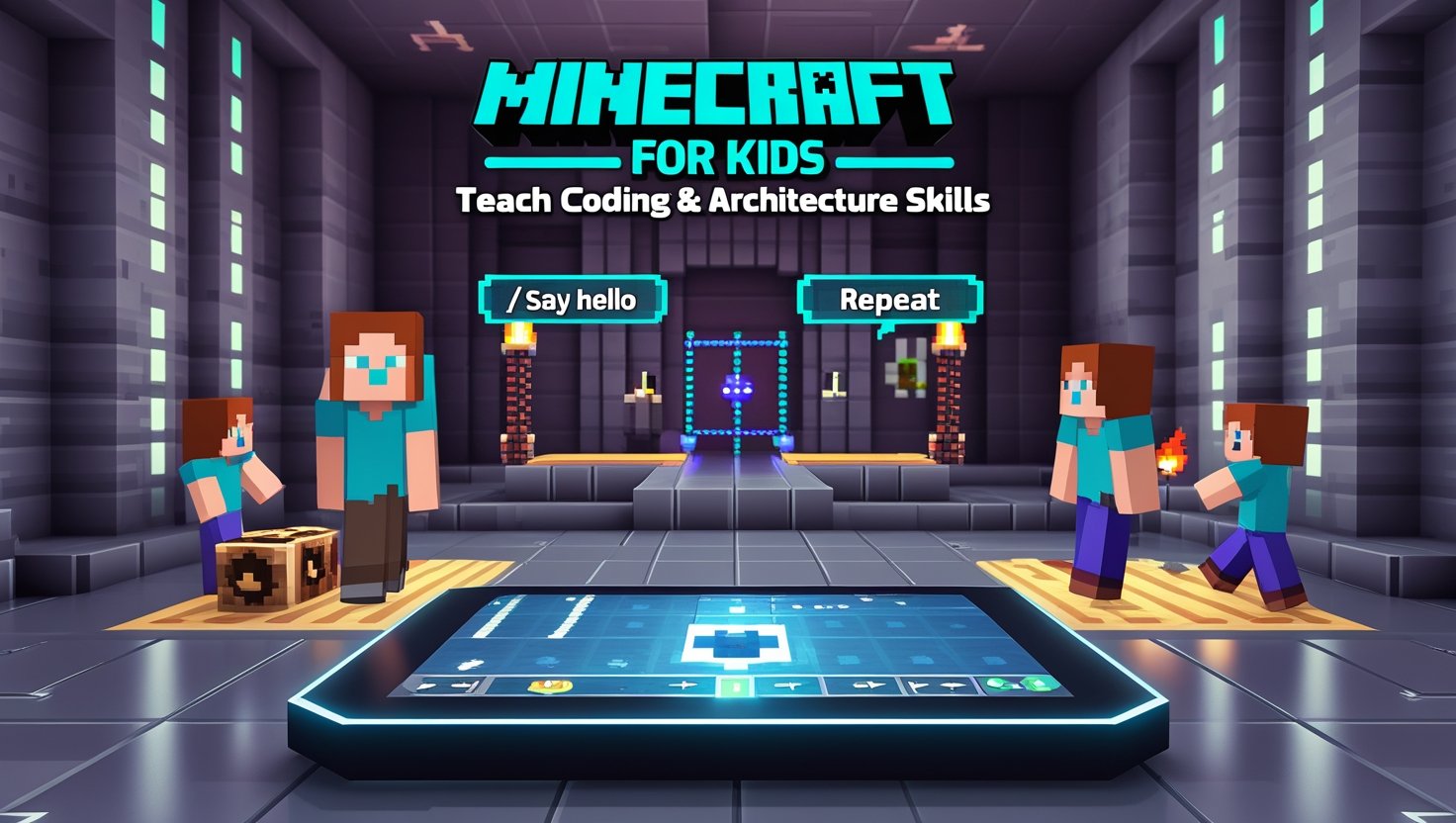
Imagine each block in a virtual world sparking creativity and curiosity in your child. Minecraft for Kids transforms playtime into an engaging classroom where kids learn to teach coding & architecture skills while having fun.
The Interactive Sandbox of Learning:
Minecraft for Kids is more than just a game, it’s an interactive sandbox that empowers young minds to explore, experiment, and express themselves. In this digital playground, children learn by doing, constructing complex worlds while absorbing lessons in engineering, design, and logic. The open-ended nature of Minecraft encourages experimentation, where mistakes lead to discoveries and creativity flows unhindered. Whether building a towering castle or a simple home, every structure is a lesson in spatial reasoning and problem-solving.
This hands-on experience fuels interest in STEM subjects, paving the way for innovative thinking. Kids can explore architectural designs and even basic coding through add-ons and mods, fostering a deep, intuitive understanding of technical concepts. The game’s immersive environment makes learning a natural and enjoyable process—a true blend of education and creativity that’s fun for every age.
Pixel Pioneers: Where Creativity Meets Code:
In Minecraft, every digital brick laid by young builders serves as an introduction to coding fundamentals. The game’s logic-driven mechanics, from redstone circuits to command blocks, subtly introduce programming logic. Kids experiment with sequences and cause-and-effect relationships without even realizing they’re learning how to code.
This playful exploration sparks an interest in the technological world, where creativity meshes with precise logic. By manipulating elements within the game, children learn to think sequentially and solve problems dynamically. Whether they’re automating a simple door mechanism or creating intricate traps, these challenges gradually build a solid foundation in coding. The hands-on, playful approach turns abstract concepts into concrete skills, nurturing a generation of digital pioneers ready to innovate.
Digital Design Studio: Mastering Architecture:
Minecraft’s block-based design isn’t just fun, it’s a gateway to the basic principles of architecture. Kids learn design concepts such as symmetry, balance, and stability while constructing both simple and complex structures. The game teaches planning and resource management as players gather materials, plan layouts, and execute their designs.
By experimenting with different building styles and techniques, young architects develop an intuitive sense of aesthetics and structural integrity. The game bridges the gap between digital design and real-world architecture, making abstract principles tangible in a playful environment. This early exposure to architectural skills can inspire future careers, as children recognize that creativity can be systematically built, brick by virtual brick.
Beyond Blocks: Exploring Coding Through Gameplay:
Minecraft for Kids offers much more than a creative outlet; it’s a powerful tool for learning coding. When children interact with the game’s engineered elements, like redstone circuits and mod integrations, they begin to appreciate the logic that underpins coding. This natural progression from play to learning builds a solid foundation in programming.
The game’s user-friendly mechanics encourage kids to explore basic concepts like loops, conditionals, and functions in an intuitive way. Such experiences demystify coding, making it accessible and enjoyable. These coding exercises, dressed as playful challenges, empower kids to experiment with problem-solving while developing a logical mindset. In essence, Minecraft transforms coding into an art form where creativity is harnessed to overcome challenges and build innovative solutions.
Collaboration in a Virtual Village:
Minecraft’s multiplayer mode creates an environment ripe for collaborative learning. Children work together to design communities, plan large-scale projects, and even solve complex puzzles. This collaborative spirit mirrors real-world teamwork, teaching valuable communication, planning, and problem-solving skills.
Through co-op projects, kids learn how to share ideas, negotiate design choices, and respect diverse perspectives. Working in teams, they experience the importance of collective brainstorming in achieving more significant creative feats. This social learning fosters both technical and interpersonal skills, preparing young users for future academic and career collaborations. Collaboration here is not just about playing a game, it’s about building communities, both virtual and real.
Customizing Worlds: The Magic of Modding:
One of Minecraft’s greatest strengths lies in its modding community. By tweaking and creating mods, kids gain an early understanding of software development and customization. This process involves learning simple programming concepts and applying them to change game dynamics. Crafting mods not only nurtures a passion for coding but also promotes problem-solving and innovation.
Modding challenges children to think about how digital environments work and inspires them to experiment with new ideas. The creative freedom to alter game mechanics encourages critical thinking and independent exploration. Moreover, participating in a vibrant modding community provides real-world feedback and collaboration opportunities. For many, modding leads to a lifelong interest in tech and design, showcasing how digital creativity can lead to tangible, real-world expertise.
Game-Based Learning: A Modern Classroom:
Minecraft represents a shift from traditional, lecture-based learning to a dynamic, game-based approach. In this modern classroom, lessons are integrated into everyday gameplay, making education immersive and engaging. Kids learn history by rebuilding historical sites, mathematics by measuring spatial coordinates, and even teamwork through collaborative builds, all within a virtual environment.
This innovative approach enhances retention and understanding by linking lessons to interactive play. The real-world applications of these skills ensure that learning doesn’t stop at the screen. Game-based learning makes education more relatable and less intimidating, allowing kids to absorb complex concepts through direct experience and play. It also highlights the value of mistakes, as each error is seen as a step toward mastery rather than a failure.
Skillful Navigation: Building Future Designers and Developers:
Minecraft is a gateway to skills that go far beyond gaming. The architectural designs children create in this digital space often reflect a growing capability in project management and visual thinking. In tandem, the coding skills fostered by the game set the stage for future careers in tech and digital artistry.
Students learn to plan, construct, and refine their work, much like a professional architect or software developer. The iterative nature of gameplay, where they repeatedly test and improve their creations, mirrors real-world development cycles. This iterative learning process teaches resilience and attention to detail, both critical in any technical field. By combining coding and architecture in an immersive environment, Minecraft equips young minds with a toolkit for future challenges.
Future Horizons: The Career-Ready Playground:
The skills fostered by Minecraft for Kids are not confined to the realm of play, they translate into real-world competencies. Early exposure to digital design and coding opens the door to careers in architecture, game design, software development, and engineering. Educational institutions are taking note, integrating game-based learning into their curricula, so students gain a head start on future technologies.
Minecraft ignites a spark that can lead to lifelong passions and rewarding careers. The game’s blend of creative design, logical structuring, and collaborative play provides a holistic educational experience that surpasses traditional teaching methods. Whether it’s pioneering a new architectural design or coding an innovative app, the foundation built through Minecraft has ripple effects far beyond the screen.
Imagination Unleashed: The Fusion of Play and Education:
At its core, Minecraft redefines learning by combining fun with education. It teaches children that curiosity and creativity are powerful tools for solving complex problems. This playful interaction with coding and architecture not only makes learning more accessible but also instills the confidence to innovate. The boundaries of the classroom expand, making every game session a potential learning breakthrough.
This seamless fusion of play and education creates a learning journey that is as enjoyable as it is enlightening. With every new structure built or code snippet created, children learn that the process of trial and error is both valuable and necessary. Such lessons remain with them far beyond their gaming years, equipping them with the mindset to tackle any challenge with enthusiasm and ingenuity.
Beyond Digital Bricks: Real-World Impact:
The impact of Minecraft extends into everyday life. Skills honed in the virtual environment translate to improved problem-solving, enhanced spatial awareness, and better teamwork abilities in the real world. The creative thinking cultivated by Minecraft lays the groundwork for a generation that is not afraid to innovate, experiment, and diverge from conventional paths.
Parents and educators alike are applauding the game’s ability to foster real-world competencies. When children learn that each virtual experiment can lead to tangible skills, the lesson is clear: technology is not an end in itself but a means to unlock limitless creativity. The game’s engaging approach reshapes how we view education, turning play into a powerful, transformative experience.
Conclusion:
Minecraft for Kids seamlessly blends creativity with technology, offering an immersive environment where every block is a lesson. It’s not just about building virtual worlds, it’s about laying the foundations for real-life skills in coding and architecture. Embrace the future of game-based learning and discover how play can become a powerful tool for education.
FAQs:
Q1: What is Minecraft for Kids?
A fun sandbox game that teaches creativity, coding, and architecture.
Q2: How does Minecraft teach coding?
Through in-game mechanics and modding that introduce programming concepts.
Q3: Can Minecraft build architecture skills?
Yes, kids learn design, planning, and structural basics while building.
Q4: Is it suitable for all ages?
Primarily designed for children, but it offers engaging lessons for all.
Q5: How does multiplayer mode help?
It fosters teamwork and collaborative problem-solving.
Q6: Where can I start?
Explore educational editions and online tutorials to begin the journey.